Kolaches are traditional Czech pastries from Central Texas that combine pillowy yeast dough with sweet fruit or savory fillings.
I stumbled into a tiny kolache shop in West, Texas (population: 2,800) at 6 AM on a road trip. The owner handed me a still-warm apricot kolache and my life changed. That buttery, cloud-like dough with its pocket of jammy fruit filling was better than any fancy pastry I’d paid $7 for in a city bakery.
The kicker? She told me her grandma’s recipe only had seven ingredients.
I went home and spent three weekends perfecting my own version. Turns out kolaches aren’t hard to make. They just need patience and the right technique.
What Makes Kolaches Different From Regular Pastries
Most people confuse kolaches with Danish pastries or even donuts.
Here’s the thing: kolaches have a unique texture that’s softer than bread but sturdier than a croissant. The dough is enriched with eggs and butter, giving it that tender crumb that practically dissolves on your tongue.
Traditional Czech kolaches always have an indentation in the center filled with fruit preserves, poppy seed, or sweet cheese. The Texan version added savory options like sausage and jalapeño because… Texas. 🌶️
| Kolache Feature | What It Means |
|---|---|
| Yeast dough | Gives that fluffy, bread-like texture |
| Fruit filling | Traditional flavors: apricot, prune, cherry, poppy seed |
| Open-faced | Filling sits in a well, not enclosed |
| Slightly sweet dough | Just enough sugar to complement both sweet and savory fillings |
What You’ll Need
For the Dough
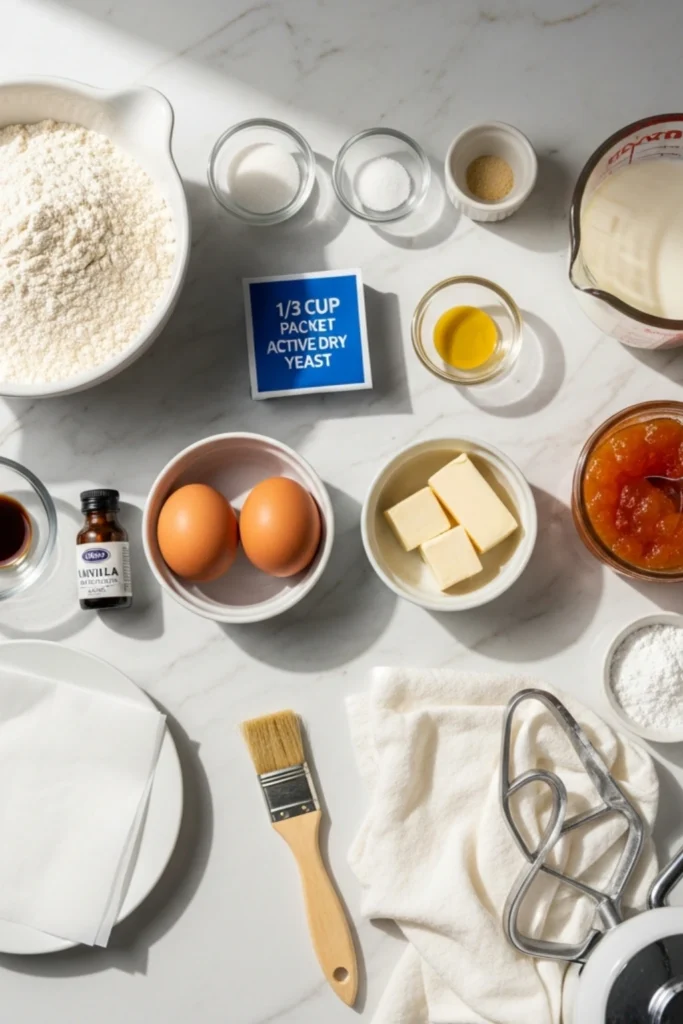
- 4 cups all-purpose flour
- 1/3 cup granulated sugar
- 1 teaspoon salt
- 2 1/4 teaspoons active dry yeast (one packet)
- 1 cup whole milk, warmed to 110°F
- 1/3 cup unsalted butter, melted and cooled slightly
- 2 large eggs, room temperature
- 1 teaspoon vanilla extract
For Sweet Fillings (Pick Your Favorite)
- 1 cup fruit preserves (apricot, prune, cherry, or blueberry)
- OR Cream cheese filling: 8 oz cream cheese (softened), 1/4 cup sugar, 1 egg yolk, 1 teaspoon vanilla
For Savory Fillings
- 1 pound breakfast sausage, cooked and crumbled
- 1 1/2 cups shredded sharp cheddar cheese
- 6 jalapeños, seeded and diced (optional but recommended)
For Finishing
- 2 tablespoons melted butter for brushing
- Powdered sugar for dusting (sweet kolaches only)
Tools Required
You don’t need a fancy kitchen for this.
- Large mixing bowl or stand mixer with dough hook
- Kitchen thermometer (milk temperature matters)
- Clean kitchen towel for covering dough
- Two baking sheets lined with parchment paper
- Pastry brush for buttering
- Measuring cups and spoons
Pro Tips From My Kitchen Failures
Temperature is everything. Your milk needs to be 105-110°F. Too hot kills the yeast. Too cold won’t activate it. Test it on your wrist like you’re checking baby formula.
Don’t rush the rise. I know waiting 90 minutes feels forever, but this is where the magic happens. Under-risen dough gives you dense, sad kolaches that taste like hockey pucks.
Make the wells DEEP. When you press your thumb into the dough to create that filling pocket, go bold. The dough rises again and will try to close up that well. I learned this the hard way when my first batch came out looking like smooth dinner rolls with a tiny dot of jam on top.
Room temperature ingredients are non-negotiable. Cold eggs shock the dough and mess with yeast activity. Set them out 30 minutes before you start, or warm them in a bowl of hot water for 5 minutes.
Freeze unbaked kolaches for easy mornings. Shape them, add filling, freeze on a baking sheet, then transfer to freezer bags. Thaw and let rise for an hour before baking. Fresh kolaches anytime you want them.
How to Make Kolaches (The Real Way)
Step 1: Wake Up Your Yeast
Pour warm milk into a small bowl. Sprinkle yeast on top and let it sit for 5-10 minutes.
You’re looking for foam. Lots of it. If nothing happens, your yeast is dead and you need to start over with a fresh packet.
Step 2: Mix the Dough
Combine flour, sugar, and salt in your stand mixer bowl (or large mixing bowl if going by hand).
Add the foamy yeast mixture, melted butter, eggs, and vanilla. Mix on low with the dough hook for 2 minutes until everything comes together in a shaggy mass.
Increase speed to medium and knead for 6-8 minutes. The dough should pull away from the bowl sides but still feel slightly sticky when you touch it. Add flour one tablespoon at a time if it’s too wet. Add milk one teaspoon at a time if it’s too dry.
Baker’s Note: The dough is ready when you can stretch a small piece thin enough to see light through it without it tearing. This is called the “windowpane test” and it’s how you know the gluten developed properly.
Step 3: First Rise
Shape dough into a ball. Place in a greased bowl, cover with a damp towel, and let it rise somewhere warm for 60-90 minutes until doubled.
I stick mine in the oven with just the light on. Creates the perfect cozy environment.
Step 4: Shape Your Kolaches
Punch down the risen dough (so satisfying). Turn it onto a lightly floured counter and roll into a log.
Cut into 16-20 equal pieces. Roll each piece into a smooth ball by cupping your hand over it and rolling in circles against the counter.
Place balls on parchment-lined baking sheets, spacing them 2 inches apart.
Step 5: Create Wells for Filling
Let the dough balls rest for 10 minutes. This relaxes the gluten and makes your life easier.
Using your thumb or the back of a spoon, press down firmly in the center of each ball. Go deep. Really deep. You want a well that’s at least 1 inch across and goes almost to the bottom.
Step 6: Fill Them Up
Spoon 1-2 tablespoons of filling into each well. For sweet kolaches, use preserves or cream cheese mixture. For savory, combine cooked sausage with cheese and jalapeños.
Don’t overfill. I learned this when my first batch oozed filling all over the pan and created a caramelized mess that took 20 minutes to scrub off.
Step 7: Second Rise
Cover filled kolaches loosely with a towel. Let them rise another 30-45 minutes until puffy.
The dough should rise up around the filling like a little pillow with a crater in the middle.
Step 8: Bake Until Golden
Preheat oven to 375°F.
Bake for 12-15 minutes until tops are golden brown and the dough around the filling looks set, not wet.
The bottoms should be lightly browned but not dark. Check one by lifting it with a spatula.
Step 9: Butter While Hot
The second these kolaches come out of the oven, brush them with melted butter. This keeps them soft and adds incredible flavor.
For sweet kolaches, wait 10 minutes then dust with powdered sugar. For savory ones, skip the sugar and eat them warm while the cheese is still melty.
Substitutions and Variations
Can’t do dairy? Swap milk for almond or oat milk and use vegan butter. The texture won’t be as rich but it works.
Want sweeter dough? Increase sugar to 1/2 cup. Great if you’re making all sweet kolaches.
No stand mixer? Mix by hand and knead on a floured surface for 10-12 minutes. You’ll get an arm workout but the results are identical.
Gluten-free attempt? Use a 1:1 gluten-free flour blend with xanthan gum already added. The texture will be denser and less fluffy, but still tasty.
Different filling ideas:
- Nutella (warm and gooey)
- Lemon curd (bright and tangy)
- Apple pie filling (use canned or homemade)
- Spinach and feta (savory Greek twist)
- Ham and Swiss (classic breakfast combo)
Make Ahead Tips
Kolaches are perfect for meal prep.
Overnight method: After shaping and filling, cover the baking sheet tightly with plastic wrap. Refrigerate overnight. In the morning, let them sit at room temperature for 30 minutes, then bake as directed.
Freeze the dough: Make dough, let it rise once, punch it down, then freeze in a greased freezer bag for up to 3 months. Thaw overnight in the fridge before shaping.
Bake and freeze: Fully bake kolaches, cool completely, freeze in an airtight container for 2 months. Reheat at 350°F for 8-10 minutes.
Nutritional Breakdown
| Nutrient | Per Kolache (fruit filling) |
|---|---|
| Calories | 195 |
| Protein | 4g |
| Carbohydrates | 28g |
| Fat | 7g |
| Fiber | 1g |
| Sugar | 10g |
| Sodium | 145mg |
Based on 18 kolaches with apricot preserves. Savory versions with sausage and cheese will have higher calories and protein.
Storage and Leftovers
Store kolaches in an airtight container at room temperature for 2-3 days. They’re best eaten fresh but stay soft if stored properly.
Don’t refrigerate them. The cold air dries out the dough faster than room temperature storage.
To reheat, microwave for 15-20 seconds or warm in a 300°F oven for 5 minutes. The oven method crisps up the bottom slightly while keeping the inside soft.
Common Kolache Problems (And How to Fix Them)
Dense, heavy texture? Your dough didn’t rise enough. Make sure you’re giving it the full time in a warm environment and that your yeast was fresh.
Filling leaked everywhere? You overfilled them or didn’t create deep enough wells. Be aggressive with that thumb press and restrain yourself on the filling amount.
Dough tastes bland? You might have forgotten the salt or vanilla. Both are crucial for flavor. Also, brushing with butter after baking makes a huge difference.
Bottoms burned but tops are pale? Your oven runs hot on the bottom. Move the rack to the upper-middle position or place another baking sheet underneath for insulation.
FAQ About Making Kolaches
Why didn’t my dough rise?
Your yeast was dead or the milk was too hot. Always check the expiration date and use a thermometer. Yeast dies at temperatures above 120°F.
Can I use instant yeast instead?
Yes. Use the same amount but add it directly to the flour. You can skip the proofing step.
How do I know when kolaches are done?
The tops should be golden brown and the dough around the filling should look set. An instant-read thermometer should read about 190°F in the center.
What’s the difference between kolaches and klobasniky?
Traditionally, kolaches are sweet with fruit or cheese filling. Klobasniky are the savory sausage-stuffed ones. But in Texas, everyone calls both of them kolaches and nobody cares about the technicality.
Can I make these without eggs?
Yes, but the texture won’t be as rich. Replace each egg with 1/4 cup unsweetened applesauce or make a flax egg (1 tablespoon ground flaxseed mixed with 3 tablespoons water, let sit 5 minutes).
My kolaches came out flat. What happened?
The dough over-proofed. If you let them rise too long, the gluten structure weakens and they collapse in the oven. Watch for “puffy” not “completely doubled again” on that second rise.
Can I use bread flour?
You can, but all-purpose flour gives better results. Bread flour has more protein, which creates a chewier texture. Kolaches should be tender and soft, not chewy.
The Czech Origins (And Why Texas Loves Them)
Kolaches came to Texas in the 1850s when Czech immigrants settled in the central part of the state.
These communities in places like West, Caldwell, and La Grange kept the tradition alive. They made kolaches for church gatherings, weddings, and weekend breakfasts. Eventually, Texas gas stations figured out that fresh kolaches were a goldmine for road-trippers.
Now you’ll find kolache shops across the state, each claiming theirs are the most authentic. The truth is, Czech cuisine has evolved differently in Texas than it did back in the Czech Republic, but both versions are delicious.
Wrapping Up
Making kolaches from scratch is easier than you think.
Yes, there’s rising time. Yes, you need patience. But the actual hands-on work is minimal. Mix, wait, shape, wait, bake. That’s it.
The reward is soft, buttery pastries that make your kitchen smell like a European bakery. You can customize the fillings however you want. And once you nail the technique, you’ll have fresh kolaches whenever the craving hits.
Try making a batch this weekend. Go half sweet with apricot preserves, half savory with sausage and jalapeños. See which ones disappear faster.
Then come back and tell me in the comments which filling combination won. I’m always looking for new ideas 👇