Bierocks (also called runzas) are German-Russian stuffed bread rolls from the Volga region filled with ground beef, cabbage, and onions.
I’m talking soft, pillowy dough wrapped around savory, perfectly seasoned filling that’s basically a complete meal in your hand.
These arrived in the American Midwest with Volga German immigrants in the 1800s, and Kansas and Nebraska basically adopted them as their own. Walk into any potluck in those states and you’ll find someone’s grandma guarding a tray of these like they’re gold.
The first time I bit into one, I was at a church fundraiser in Kansas. The outside was golden and buttery, the inside was this incredible mix of tender beef and sweet cabbage that had soaked up all the meat juices.
I went back for three more.
Now I make them every other week because they freeze perfectly and reheat like a dream. Pop one in the microwave for 90 seconds and you’ve got a better lunch than anything you’d grab on your way to work.
What You’ll Need
For the Dough
| Ingredient | Amount | Notes |
|---|---|---|
| Warm whole milk | 1 cup | 110°F, not hotter |
| Granulated sugar | ⅓ cup | Feeds the yeast |
| Active dry yeast | 2¼ tsp | One standard packet |
| Unsalted butter, melted | ⅓ cup | Can use salted, reduce salt |
| Salt | 1 tsp | Essential for flavor |
| Large egg | 1 | Room temp works best |
| All-purpose flour | 3½-4 cups | Add gradually |
For the Filling
| Ingredient | Amount | Notes |
|---|---|---|
| Ground beef | 1½ lbs | 80/20 blend ideal |
| Yellow onion, diced | 1 medium | Sweet onion works too |
| Green cabbage, chopped | 3 cups | Finely chopped |
| Garlic, minced | 3 cloves | Fresh only |
| Salt | 1 tsp | Season to taste |
| Black pepper | ½ tsp | Freshly ground |
| Paprika | ½ tsp | Adds depth |
| Caraway seeds | ¼ tsp | Optional but traditional |
For Assembly
- Melted butter: 2 tablespoons (for brushing before and after baking)
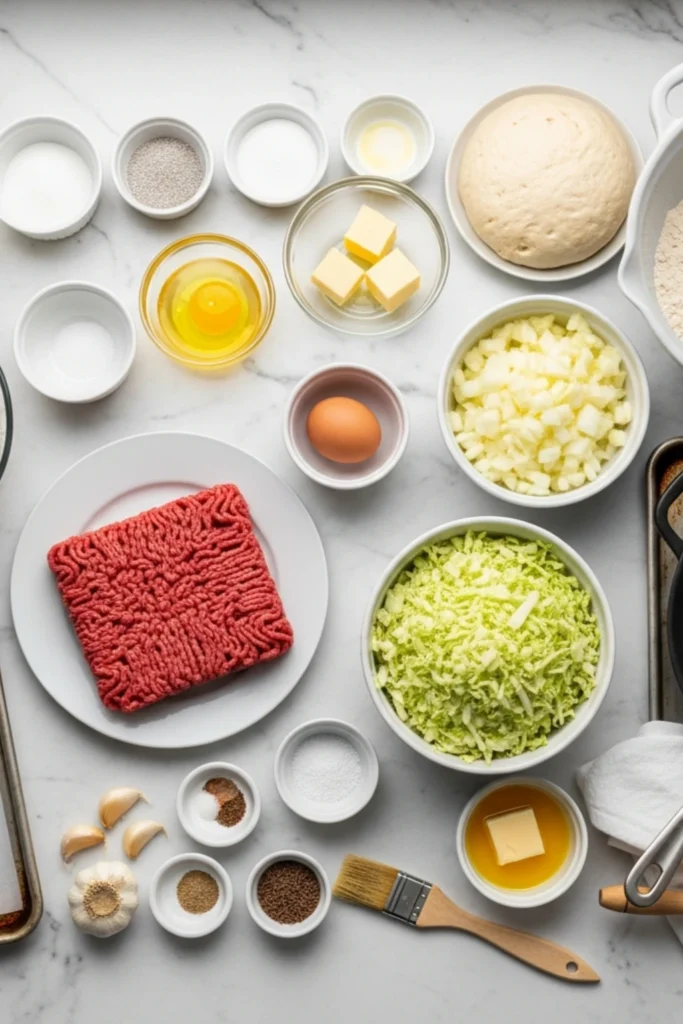
Tools You’ll Need
You probably have all of this already:
- Large mixing bowl
- Medium skillet or sauté pan
- Rolling pin
- Baking sheet (or two if making a double batch)
- Parchment paper
- Clean kitchen towel
- Pastry brush
- Kitchen scale (optional but helpful for portioning)
Pro Tips
Cool the filling completely before assembling. Hot filling will make your dough soggy and nearly impossible to seal properly. I make the filling first and stick it in the fridge while the dough rises.
Don’t overstuff them. Use about ¼ cup of filling per bierock. Your instinct will be to pack in more, but overfilled ones burst open during baking and make a mess of your pan.
Seal the edges like you mean it. Press firmly and crimp with a fork. Any gaps = filling leaking everywhere.
Freeze before baking for meal prep. Shape them, freeze on a baking sheet until solid, then transfer to freezer bags. Bake straight from frozen when you need them.
Double brush with butter. Once before baking for color, once after for that glossy professional finish.
Substitutions and Variations
Meat Options
Ground pork: Gives a slightly sweeter flavor and works perfectly
Ground turkey: Leaner option, add an extra tablespoon of oil when cooking
Italian sausage: Remove from casings, adds great flavor without extra seasoning
Half beef, half sausage: My personal favorite combo
Vegetarian: Sautéed mushrooms + cooked lentils + extra garlic
Vegetable Swaps
| Instead of | Use This | Result |
|---|---|---|
| Green cabbage | Red cabbage | Sweeter flavor, pretty color |
| Fresh cabbage | Sauerkraut (drained) | Tangier, more traditional |
| All cabbage | Half cabbage, half shredded carrots | Added sweetness |
Flavor Variations
Add cheese: Shredded cheddar or Swiss mixed into the filling (not traditional but delicious)
Spice it up: Add ½ teaspoon of red pepper flakes or a diced jalapeño
Herb it: Fresh thyme or oregano instead of caraway
Go mild: Skip the caraway if you don’t like that anise-like flavor
Make Ahead Tips
This is where bierocks really shine for busy people.
The Filling (Up to 2 Days Ahead)
Cook completely, cool, and refrigerate in an airtight container. Cold filling is actually easier to work with during assembly.
The Dough (Overnight)
Make the dough, let it rise once, punch down, and refrigerate. Let it come to room temperature (about 30 minutes) before rolling out.
Assembled But Unbaked (Up to 3 Months)
This is the best make-ahead method:
- Shape your bierocks completely
- Place on a parchment-lined baking sheet
- Freeze until solid (about 2 hours)
- Transfer to freezer bags
- Bake straight from frozen, adding 5-10 minutes to baking time
Fully Baked (Up to 2 Months)
Cool completely, wrap individually in plastic wrap, then store in freezer bags. Reheat in the microwave or oven.
How to Make Bierocks
Step 1: Activate the Yeast
Pour the warm milk into a large bowl. The temperature matters here – too hot kills the yeast, too cold and it won’t activate. Aim for 110°F, or “baby bottle warm.”
Add the sugar and yeast. Stir gently and let it sit for 5-10 minutes.
You’re looking for it to get foamy and bubbly on top. No foam? Your yeast is dead or your milk was too hot. Start over.
Step 2: Make the Dough
Once your yeast mixture is foamy, add the melted butter, salt, and egg. Whisk it together until combined.
Start adding flour one cup at a time, stirring after each addition.
The dough should pull away from the sides of the bowl but still feel slightly sticky. Don’t add too much flour trying to make it completely dry – a little tackiness is good.
Turn it out onto a lightly floured surface and knead for 5 minutes. You want it smooth and elastic.
Place in a greased bowl, cover with a kitchen towel, and let it rise somewhere warm for about 1 hour. It should double in size.
Step 3: Cook the Filling
While the dough rises, heat a large skillet over medium-high heat.
Add the ground beef and cook, breaking it apart with a wooden spoon, until browned all over. This takes 5-7 minutes.
Add the diced onion and cook for 3-4 minutes until soft.
Toss in the cabbage and garlic. Keep cooking and stirring occasionally until the cabbage is tender, about 8-10 minutes. The cabbage will shrink down a lot.
Season with salt, pepper, paprika, and caraway seeds if using. Stir everything together.
Transfer to a bowl and let it cool completely. Stick it in the fridge to speed this up.
Step 4: Shape the Bierocks
Once your dough has doubled, punch it down to deflate it.
Turn it out onto a lightly floured surface and divide into 12 equal pieces. A kitchen scale helps here – each piece should be about 2.5-3 ounces.
Roll each piece into a ball, then use a rolling pin to flatten it into a circle about 5-6 inches across.
Spoon ¼ cup of cooled filling into the center of each circle.
Bring the edges up and over the filling, pinching them together at the top to seal. Pinch all the seams closed tightly.
Flip it over so the seam side is down and place on a parchment-lined baking sheet, spacing them about 2 inches apart.
Step 5: Second Rise
Cover the shaped bierocks with a clean kitchen towel and let them rise for 20-30 minutes. They should puff up slightly.
While they rise, preheat your oven to 375°F.
Step 6: Bake
Brush the top of each bierock with melted butter.
Bake for 18-22 minutes until golden brown on top. They should sound slightly hollow when you tap the bottom.
As soon as they come out of the oven, brush them again with melted butter for that gorgeous glossy finish.
Let them cool for 5 minutes before eating. The filling is lava-hot inside.
Nutritional Information
Per bierock (makes 12):
| Nutrient | Amount |
|---|---|
| Calories | 310 |
| Protein | 15g |
| Carbohydrates | 35g |
| Fat | 12g |
| Fiber | 2g |
| Sugar | 6g |
| Sodium | 380mg |
These numbers are approximate and vary based on exact ingredients used.
What to Serve With Bierocks
Traditional pairing: Bierocks are served with pickles and mustard in German-Russian communities. The tanginess cuts through the richness perfectly.
Honestly, these are a complete meal on their own, but if you want sides:
Dill pickles – Traditional and my favorite pairing
Spicy brown mustard – For dipping or spreading inside
Simple green salad – Light vinaigrette keeps things balanced
Tomato soup – Makes it feel like the coziest dinner ever
Roasted vegetables – Carrots, Brussels sprouts, or green beans
German potato salad – If you’re going full traditional
Leftovers and Storage
Refrigerator Storage
Store cooled bierocks in an airtight container for up to 4 days.
Reheat: Microwave for 45-60 seconds, or bake at 350°F for 10 minutes if you want the outside crispy again.
Freezer Storage
Method 1 (Unbaked): Freeze shaped bierocks on a baking sheet until solid, then transfer to freezer bags. Good for 3 months. Bake straight from frozen at 375°F for 25-30 minutes.
Method 2 (Baked): Wrap each bierock individually in plastic wrap, then place all in a freezer bag. Good for 2 months. Microwave for 90 seconds or bake at 350°F for 15-20 minutes.
FAQ
Can I use store-bought dough?
Yes, but it won’t taste the same. Rhodes frozen dinner rolls work in a pinch – let them thaw and rise, then roll out and fill as directed. The homemade dough is what makes these special though.
Why isn’t my dough rising?
Three common reasons: expired yeast, milk was too hot (killed the yeast), or your kitchen is too cold. Try putting the bowl in a slightly warm oven (heat to 200°F for 1 minute, then turn off).
Can I use pre-shredded cabbage?
Absolutely. Coleslaw mix works great, just make sure it’s finely shredded so it cooks down properly.
Do I have to use caraway seeds?
Nope. They give that traditional slightly anise-like flavor, but plenty of people skip them. I do half the time.
Can I make mini bierocks?
Yes! Divide the dough into 24 pieces instead of 12, use about 2 tablespoons of filling per mini, and reduce baking time to 12-15 minutes.
How do I know when they’re done?
They should be golden brown on top and sound slightly hollow when you tap the bottom. Internal temperature should hit 190°F if you want to be precise.
Can these be made in an air fryer?
I haven’t tested it myself, but readers have had success at 350°F for 12-15 minutes. Check halfway through and adjust as needed.
What’s the difference between bierocks and runzas?
They’re the same thing. “Bierock” is the German name, “runza” is the Americanized version popular in Nebraska. Same delicious stuffed bread.
Wrapping Up
Bierocks might seem like a project recipe, but once you make them, you’ll realize they’re actually pretty straightforward.
The dough comes together easily, the filling is basically just browning meat and sautéing cabbage, and the assembly is kind of meditative once you get into a rhythm.
Plus, they’re incredibly practical. Make a double batch, freeze half, and you’ve got better-than-takeout meals ready to go for weeks.
The best part? Your kitchen will smell absolutely incredible while they’re baking. That buttery, savory aroma is worth the effort alone.
Have you made bierocks before? Or is this your first time hearing about them? Drop a comment below and let me know how yours turned out, or if you have any questions before you give them a try! 💛