The lau lau recipe you’ve been looking for is finally here, and it’s every bit as deeply satisfying as the real thing you’d find at a Hawaiian plate lunch spot.
Lau lau is a traditional Hawaiian dish from the islands of Hawaii, made by wrapping seasoned pork and butterfish in taro leaves, then steaming the whole bundle low and slow until everything melts into something that genuinely stops you mid-bite.
And here’s what most people don’t know going in: the taro leaves don’t just wrap the meat. They transform it. They soak up every drop of fat and juice, turning silky and rich in a way that no sauce could replicate.
This isn’t a quick weeknight throw-together. It’s a slow, intentional cook, and every minute of the wait is worth it.
What You’ll Need
Protein
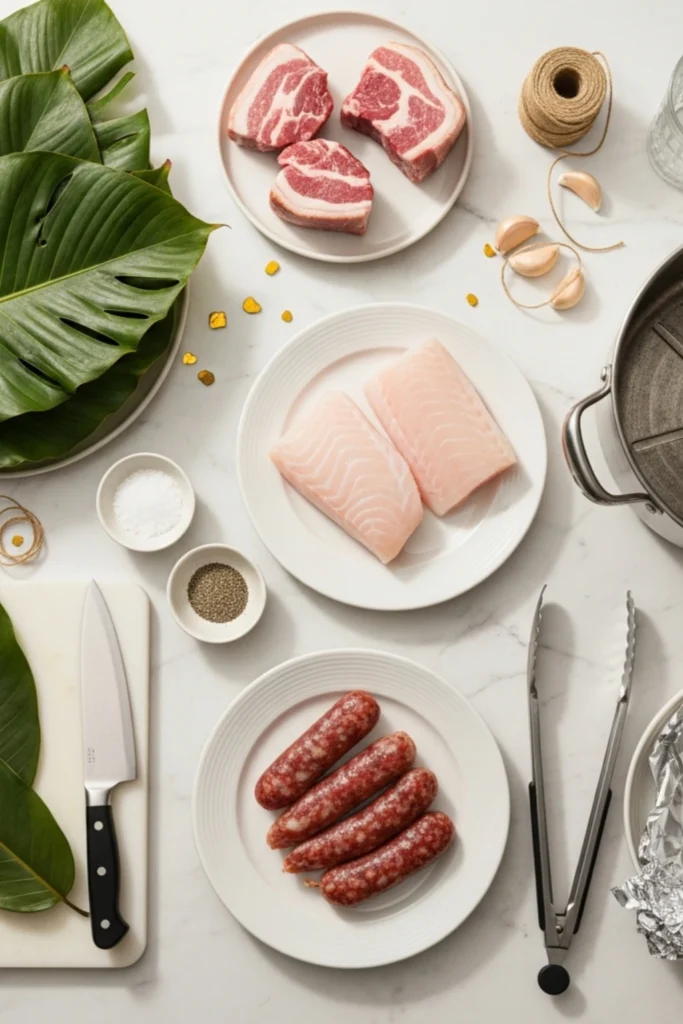
- 1.5 lbs pork butt, cut into 4 equal chunks
- 4 pieces butterfish (black cod), about 2 oz each
- 4 pieces lup cheong sausage (optional, but highly recommended)
Wrapping
- 12–16 large fresh taro (luau) leaves, stems fully removed
- 4 ti leaves for the outer wrap (or banana leaves, or heavy-duty foil)
Seasoning
- 1 tsp Hawaiian sea salt (or coarse kosher salt)
- ½ tsp black pepper
Tools You’ll Need
- Large steamer pot with a tight-fitting lid
- Steamer basket that fits inside the pot
- Kitchen twine or toothpicks
- Sharp chef’s knife
- Cutting board
- Tongs
- Aluminum foil (backup if no ti leaves)
Pro Tips
Making lau lau for the first time? These tips will save you from the most common mistakes:
- Never skip the butterfish. Black cod is loaded with fat, and that fat is what slow-bastes the pork during steaming. Use a lean fish and you lose everything that makes this dish special.
- Go heavy on the taro leaves. Use 3–4 leaves per bundle minimum. Too few and the pork won’t get properly coated in that silky, savory green layer.
- Steam the full 4–5 hours. Three hours will technically cook the pork, but five hours is where lau lau becomes lau lau. The leaves soften completely and the flavors deepen in a way that shorter cooking just doesn’t achieve.
- Remove every bit of the stem. Taro leaf stems contain calcium oxalate crystals that cause throat irritation if not fully cooked down. Trim them completely before wrapping and steam long enough to eliminate any remaining crystals.
- Wrap tight and wrap confident. A loose bundle opens up during steaming and the pork dries out. Wrap as though your dinner depends on it, because it genuinely does.
Substitutions and Variations
Can’t find every ingredient at your local grocery store? Here’s how to adapt:
| Original Ingredient | Best Substitute |
|---|---|
| Taro (luau) leaves | Collard greens or Swiss chard |
| Ti leaves (outer wrap) | Banana leaves or heavy-duty foil |
| Butterfish (black cod) | Salmon or mackerel (fatty fish only) |
| Pork butt | Pork belly or pork shoulder |
| Hawaiian sea salt | Coarse kosher salt |
| Lup cheong sausage | Any cured pork sausage |
Chicken lau lau: Swap pork for bone-in, skin-on chicken thighs. Keep the butterfish in for moisture.
Vegetarian lau lau: Use extra-firm tofu and king oyster mushrooms. Not traditional, but the taro leaf wrap still does its thing.
Make Ahead Tips
Good news: lau lau actually tastes better the next day. 🙌
- Prep bundles up to 24 hours ahead. Wrap them fully, refrigerate unbundled until you’re ready to steam.
- Cook and refrigerate. Fully steamed lau lau keeps well in the fridge for 3–4 days.
- Freeze for up to 3 months. Cool completely, wrap tightly in foil, then seal in a freezer bag. Reheat by steaming 35–45 minutes from frozen.
How to Make Lau Lau
Prep Time: 30 minutes | Cook Time: 4–5 hours | Servings: 4 bundles
Step 1: Prep the Taro Leaves
Rinse each leaf thoroughly under cold water.
Cut the stems off completely, including any thick rib running up the base of the leaf. No exceptions.
Step 2: Season the Pork
Cut pork butt into 4 equal chunks. Season all sides generously with Hawaiian sea salt and black pepper.
Step 3: Build the Bundles
Lay 3–4 taro leaves flat, stacked and overlapping. Place one chunk of pork in the center. Add one piece of butterfish on top. Add lup cheong if using.
Fold the leaves up and around the filling, enclosing it completely like a tight parcel.
Step 4: Add the Outer Wrap
Lay a ti leaf flat. Place the taro bundle in the center and fold the ti leaf up around it. Tie with kitchen twine or secure with toothpicks.
No ti leaves? Wrap tightly in a double layer of heavy-duty foil.
Step 5: Steam
Fill your steamer pot with 2–3 inches of water. Bring to a boil.
Place bundles seam side up in the steamer basket. Cover tightly.
Steam on medium-high for 4–5 hours, checking every 45–60 minutes to top up the water as needed.
💡 Key tip: Don’t let the pot run dry. If you lose steam, you lose moisture inside the bundles.
Step 6: Check for Doneness
Carefully unwrap one bundle. The pork should fall apart with zero resistance. The taro leaves should be dark green, silky, and completely soft with no bitterness or grittiness.
Not there yet? Rewrap and give it another 30–60 minutes.
Step 7: Serve
Open bundles at the table for full effect. Serve over steamed white rice and pair with poi and Hawaiian macaroni salad for the full plate lunch experience.
Nutritional Breakdown
(Per bundle, approximate)
| Nutrient | Amount |
|---|---|
| Calories | ~420 |
| Protein | ~38g |
| Fat | ~26g |
| Carbohydrates | ~4g |
| Fiber | ~2g |
| Sodium | ~620mg |
Naturally gluten-free, high-protein, and low-carb as written. According to the USDA FoodData Central, taro leaves are also a surprisingly solid source of vitamins A and C.
Meal Pairing Suggestions
Lau lau is the centerpiece. Build the rest of your plate around it:
- Steamed white rice — non-negotiable in most Hawaiian households
- Poi — traditional fermented taro paste, tangy and earthy
- Hawaiian macaroni salad — creamy, cold, the perfect contrast
- Lomi lomi salmon — fresh, chilled tomato and salmon salad
- Haupia — coconut pudding for dessert
Leftovers and Storage
This dish was practically made for leftovers. 🍱
- Fridge: Store in an airtight container for up to 4 days. Flavors deepen overnight.
- Freezer: Wrap individual portions tightly in foil, seal in a zip-lock bag. Good for 3 months.
- Reheating from fridge: Steam for 15–20 minutes, or microwave covered with a damp paper towel.
- Reheating from frozen: Steam for 35–45 minutes straight from frozen.
Do not reheat in a dry skillet. You’ll cook off all the moisture that makes lau lau what it is.
FAQ
Can I make lau lau without taro leaves?
Yes. Collard greens are the most-used substitute and hold up well to long steaming. Swiss chard works too, though the flavor is slightly milder.
Where do I find taro (luau) leaves?
Check Asian grocery stores, Hawaiian specialty markets, or large international supermarkets. Many online grocers ship them as well.
Why does my throat feel prickly after eating taro leaves?
This means the leaves weren’t cooked long enough. The calcium oxalate crystals in taro leaves need to be fully broken down during steaming. Always remove stems, always steam for at least 4 hours.
Can I use a slow cooker?
Technically yes, but the texture won’t be the same and the bundles won’t hold their shape as well. If you do go that route, cook on low for 8 hours.
Is this lau lau recipe gluten-free?
Yes, as written. Just check the label on your lup cheong sausage if you’re including it.
Can I scale this recipe up for a group?
Absolutely. Scale the ingredients proportionally and steam in batches if your steamer pot can’t fit everything in a single layer.
Wrapping Up
Lau lau is a recipe that asks something of you: patience.
You can’t rush the steam, can’t cut the time short, and can’t fake what happens when pork and butterfish slow-cook inside taro leaves for five hours.
But when you open that bundle and the steam rolls out? You’ll understand exactly why Hawaiians have been making this dish for generations. It’s comfort food at a level that’s genuinely hard to match.
Try it this weekend. And when you do, leave a comment below! Tell me how it went, what substitutions you made, whether you went the full plate lunch route, and any questions that came up along the way. I read every single one. 👇