You’ve had burritos before. But a Mission-style burrito? That’s a completely different experience.
This isn’t the sad, half-wrapped thing you grab at a gas station. A true Mission burrito — born in San Francisco’s Mission District in the 1960s — is a massive, foil-wrapped torpedo stuffed to the point of defying physics.
Rice inside. Beans inside. A full meal, inside another meal. And somehow it all works perfectly together.
Once you make this at home, you’ll wonder why you ever paid $18 for one at a restaurant.
What Makes a Mission-Style Burrito Different?
Most people don’t realize this, but the Mission-style burrito is actually a regional style — not just “a burrito.”
It originated in San Francisco’s Mission District, where taquerias like El Faro (opened 1961) started wrapping giant flour tortillas around rice, beans, meat, sour cream, cheese, salsa, and guacamole — all in one bundle.
The key differences from other burritos:
- The size. It’s huge. Intentionally.
- Rice is always included (Tex-Mex burritos often skip this).
- It’s steamed after wrapping to make the tortilla pliable and seal everything in.
- Foil-wrapped so it holds together as you eat.
- No hard shell, no lettuce — this isn’t a Tex-Mex burrito.
Here’s the surprising part: that tight, professional wrap is actually a skill. Keep reading — I’ll show you exactly how to nail it.
What You’ll Need
For the Cilantro-Lime Rice
- 1 cup long-grain white rice
- 2 cups water or low-sodium chicken broth
- 1 tablespoon butter
- 1/2 teaspoon salt
- Juice of 1 lime
- 1/4 cup fresh cilantro, chopped
For the Seasoned Pinto Beans
- 1 can (15 oz) pinto beans, drained and rinsed
- 1/2 cup chicken or vegetable broth
- 1/2 teaspoon cumin
- 1/2 teaspoon garlic powder
- Salt to taste
For the Carne Asada (Grilled Steak)
- 1.5 lbs flank steak or skirt steak
- 3 tablespoons fresh lime juice
- 2 tablespoons orange juice
- 3 cloves garlic, minced
- 1 teaspoon cumin
- 1 teaspoon chili powder
- 1 teaspoon smoked paprika
- 1 tablespoon olive oil
- Salt and black pepper to taste
For the Pico de Gallo
- 3 roma tomatoes, diced
- 1/2 white onion, finely diced
- 1 jalapeño, seeded and minced
- 1/4 cup fresh cilantro, chopped
- Juice of 1 lime
- Salt to taste
For the Guacamole
- 2 ripe Hass avocados
- Juice of 1 lime
- 1/4 teaspoon salt
- 1/4 teaspoon garlic powder
The Assembly
- 4 extra-large (12-inch) flour tortillas
- 1 cup shredded Mexican blend cheese or Monterey Jack
- 1 cup sour cream
- Foil sheets (one per burrito)
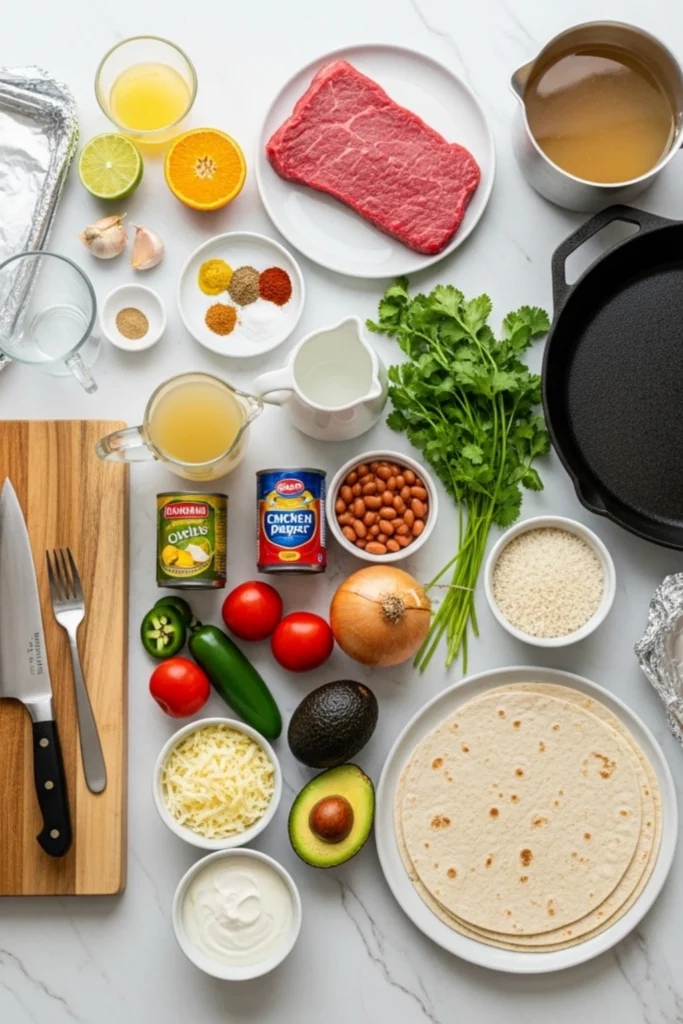
Tools You’ll Need
- Large skillet or cast iron pan (for the steak)
- Medium saucepan (for rice and beans)
- Cutting board and sharp knife
- Mixing bowls (for guacamole and pico)
- Meat thermometer (optional but helpful)
- Aluminum foil
- Tongs
- Fork or potato masher (for guacamole)
Pro Tips
1. Steam your tortilla before wrapping. Lay the tortilla on a warm skillet for 20-30 seconds per side, or wrap in a damp paper towel and microwave for 30 seconds. A warm, pliable tortilla is the only way to get a tight wrap without it tearing.
2. Don’t overstuff — even though you want to. This is where most people go wrong. Leave at least 2 inches of empty space on the sides and bottom of the tortilla before you fold. You can stuff it impressively full and still close it properly if you leave that edge.
3. Season your rice while it’s hot. Stir in the lime juice and cilantro the moment the rice comes off the heat. It absorbs the flavor completely instead of just coating the outside.
4. Rest your steak. Give the carne asada at least 5 minutes to rest before slicing. Cut against the grain at an angle for the most tender bite. Skipping this step turns great steak into chewy steak.
5. Warm your beans with liquid. Don’t just dump cold beans from a can. Simmer them in broth with spices for 5-7 minutes. This small step makes them taste like they’ve been slow-cooked all day.
Substitutions and Variations
| Ingredient | Swap |
|---|---|
| Carne asada | Grilled chicken, carnitas, sofritas (sautéed spiced tofu), or shrimp |
| Pinto beans | Black beans (equally authentic in Mission burritos) |
| White rice | Brown rice, cauliflower rice (lower carb), or skip entirely |
| Sour cream | Greek yogurt works great if you want more protein |
| Flour tortilla | Spinach or whole wheat tortillas for variety |
| Monterey Jack | Cotija cheese crumbles for a more authentic flavor |
For a vegetarian version: Skip the meat entirely and double the beans. Add sautéed peppers and mushrooms. You won’t miss it.
For a dairy-free version: Skip the cheese and sour cream. Add extra guacamole and a drizzle of tahini-lime sauce.
Make Ahead Tips
The beauty of this recipe is that almost every component can be made ahead.
- Rice: Cook up to 3 days ahead and refrigerate. Reheat with a splash of water in a covered pan.
- Beans: Cook and refrigerate for up to 4 days.
- Carne asada marinade: Marinate the steak in the fridge for up to 24 hours (8 hours minimum is ideal).
- Pico de gallo: Make the day before — the flavors get even better overnight.
- Guacamole: Make day-of only. Press plastic wrap directly onto the surface to prevent browning.
This makes it a genuinely great meal prep recipe — cook everything Sunday, assemble burritos through the week.
How to Make a Mission-Style Burrito
Step 1: Marinate the Carne Asada
In a bowl, combine lime juice, orange juice, garlic, cumin, chili powder, smoked paprika, olive oil, salt, and pepper.
Add the flank steak and coat completely. Cover and refrigerate for at least 2 hours, up to 24 hours.
The acid in the citrus breaks down the muscle fibers, making it noticeably more tender. Don’t skip this step.
Step 2: Cook the Rice
Bring water or broth to a boil in a saucepan. Add the rice, butter, and salt. Reduce to a simmer, cover, and cook for 18 minutes.
Remove from heat. Let it sit, covered, for 5 minutes. Then fluff with a fork, stir in the lime juice and cilantro immediately. Set aside.
Step 3: Make the Pico de Gallo
Combine the diced tomatoes, white onion, jalapeño, cilantro, and lime juice. Mix well, season with salt, and let it sit for at least 10 minutes.
That resting time is where the magic happens — the ingredients release liquid and meld together into something much better than just chopped vegetables.
Step 4: Make the Guacamole
Halve the avocados, remove the pits, and scoop the flesh into a bowl. Add lime juice, salt, and garlic powder.
Mash with a fork to your preferred texture — some people like it chunky, some smooth. Both work perfectly in a burrito.
Step 5: Cook the Beans
Add the drained beans, broth, cumin, and garlic powder to a small saucepan over medium heat. Simmer for 5-7 minutes until the liquid is mostly absorbed. Season with salt. Keep warm.
Step 6: Grill the Carne Asada
Heat a cast iron skillet or grill pan over high heat until very hot. Remove the steak from the marinade and pat it slightly dry (excess liquid steams instead of sears).
Cook for 4-5 minutes per side for medium-rare, or until internal temperature reaches 135°F. Rest for 5 minutes, then slice against the grain into thin strips.
This sear is what gives you those charred, slightly smoky edges that make the whole burrito come together.
Step 7: Warm the Tortillas
Heat each 12-inch flour tortilla in a dry skillet over medium heat for 20-30 seconds per side, until warm and pliable. Or wrap in a damp paper towel and microwave for 30 seconds.
Work with one tortilla at a time — they cool quickly.
Step 8: Assemble
Lay the warm tortilla flat. In the center, layer in this order:
- Rice (about 1/2 cup) — spread in a rectangle, not a circle
- Beans (1/4 cup)
- Carne asada strips (generous portion)
- Pico de gallo (2-3 tablespoons)
- Guacamole (2 tablespoons)
- Sour cream (2 tablespoons)
- Shredded cheese (a small handful)
Keep everything in the lower-center third of the tortilla, leaving 2 inches on each side.
Step 9: Wrap Like a Pro
This is the step most people mess up. Here’s exactly how to do it:
- Fold the left and right sides of the tortilla inward over the filling.
- Hold those sides in place with your fingers.
- Fold the bottom flap up and over the filling, tucking it tightly underneath.
- Roll the burrito away from you in one firm, continuous motion, keeping the sides tucked as you go.
- Place the finished burrito seam-side down on a piece of foil.
- Wrap the foil tightly around the entire burrito.
That foil isn’t just for aesthetics. It holds the wrap together while you eat, keeps it warm, and honestly makes the whole experience feel more authentic.
Nutrition Breakdown (Per Burrito, Approximate)
| Nutrient | Amount |
|---|---|
| Calories | ~720-850 kcal |
| Protein | 42-48g |
| Carbohydrates | 75-85g |
| Fat | 28-35g |
| Fiber | 10-12g |
| Sodium | 900-1100mg |
This is a full, satisfying meal on its own. Adjust portion sizes for individual needs.
For higher protein: Double the carne asada, reduce rice by half. You’ll hit 55g+ protein easily.
For lower carb: Skip the rice entirely or sub cauliflower rice. The beans, steak, guac, and cheese carry the flavor completely on their own.
Meal Pairing Suggestions
A Mission burrito is a complete meal by itself, but if you’re serving a crowd:
- On the side: Tortilla chips with extra pico or a simple green salad with lime vinaigrette
- Drinks that work perfectly: Agua fresca, horchata, or a classic margarita
- For a full spread: Add a pot of refried beans and Mexican street corn (elote) on the side
Leftovers and Storage
| Component | Fridge | Freezer |
|---|---|---|
| Assembled burritos | 3-4 days, wrapped in foil | Up to 3 months |
| Cooked carne asada | 3-4 days | 2-3 months |
| Cooked rice | 4-5 days | 1 month |
| Pico de gallo | 2-3 days | Not recommended |
| Guacamole | 1-2 days (press wrap to surface) | Not recommended |
To reheat: Keep the burrito wrapped in foil and heat in a 350°F oven for 15-20 minutes. For a crisper exterior, unwrap and finish in a dry skillet for 2 minutes per side.
Don’t microwave if you can avoid it. The tortilla gets soggy. The oven method keeps the texture right.
FAQ
Can I use store-bought guacamole and salsa to save time?
Yes, and no one will judge you for it. The homemade versions add noticeably better flavor, but if you’re pressed for time, quality store-bought versions work fine. Trader Joe’s pico de gallo is a solid shortcut.
What’s the best cut of beef for carne asada?
Flank steak and skirt steak are the traditional choices. Skirt steak has slightly more fat and a richer flavor. Flank steak is leaner and a bit easier to slice. Both are excellent here.
My burrito keeps falling apart. What am I doing wrong?
Almost always, it’s one of two things: the tortilla wasn’t warm enough (not pliable), or there was too much filling. Warm the tortilla right before wrapping, and keep the fillings tightly mounded in the center — not spread to the edges.
Can I make this without a grill or cast iron pan?
A regular stainless steel skillet works. Just make sure it’s very hot before the steak goes in. The key is high heat and a dry pan for that sear.
Is this really authentic to San Francisco’s Mission District?
The Mission-style burrito is a specific regional style, and yes — rice, beans, and all the fillings wrapped in a large flour tortilla and foil-wrapped is exactly how it’s served at the legendary taquerias like La Taqueria and El Farolito on Mission Street.
Can I meal prep these as full burritos?
Absolutely. Wrap tightly in foil, label, and refrigerate for up to 4 days or freeze for up to 3 months. They reheat beautifully in the oven.
Wrapping Up
A Mission-style burrito isn’t complicated. It’s just a lot of good things, done right, wrapped together.
Once you make it at home, you’ll realize the secret isn’t some special ingredient or technique. It’s care. The marinated steak that actually has time to soak. The rice that gets the lime while it’s still hot. The guacamole made fresh. The tortilla that’s warm when you fold it.
Small things. Big difference.
Now make it, eat it (possibly in one sitting), and drop a comment below. Tell me which protein you used, how the wrap went on your first try, and whether you’ll ever go back to buying a $18 burrito at a restaurant again.