Pacific oysters — known as Crassostrea gigas along the West Coast of the USA and Canada — are one of the most underrated ingredients you can cook at home.
And yet most people assume they’re restaurant-only territory.
They’re not. Once you shuck your first dozen, you’ll wonder why you ever paid $4 each for something this easy to make yourself.
Fun fact: Pacific oysters were originally cultivated in Japan and brought to the Pacific Northwest in the early 1900s. Today, they’re the most farmed oyster in the world — and Washington State alone produces over 10 million pounds per year.
Stick around — there’s one tip near the end that most home cooks completely skip, and it changes the flavor dramatically.
What You’ll Need
Raw Pacific Oysters with Classic Mignonette (Serves 2–4)
| Ingredient | Amount |
|---|---|
| Fresh Pacific oysters, scrubbed | 12 |
| Rice wine vinegar (or white wine vinegar) | 1/4 cup |
| Small shallot, very finely minced | 1 |
| Freshly cracked black pepper | 1 tsp |
| Sea salt | 1/2 tsp |
| Fresh lemon juice | 1 tbsp |
| Lemon wedges | For serving |
| Crushed ice or rock salt | For presentation |
Garlic Butter Baked Pacific Oysters (Serves 2–4)
| Ingredient | Amount |
|---|---|
| Fresh Pacific oysters, shucked on half shell | 12 |
| Unsalted butter, softened | 4 tbsp |
| Garlic cloves, minced | 3 |
| Fresh flat-leaf parsley, finely chopped | 2 tbsp |
| Lemon juice | 1 tbsp |
| Red pepper flakes | 1/4 tsp |
| Freshly grated Parmesan cheese | 1/4 cup |
| Sea salt and black pepper | To taste |
| Lemon wedges | For serving |
Pan-Seared Pacific Oysters (Serves 2)
| Ingredient | Amount |
|---|---|
| Fresh Pacific oysters, shucked | 12 |
| Unsalted butter | 2 tbsp |
| Olive oil | 1 tbsp |
| Garlic cloves, minced | 2 |
| Dry white wine | 1/4 cup |
| Fresh lemon juice | 1 tbsp |
| Fresh flat-leaf parsley, chopped | 1 tbsp |
| Sea salt and black pepper | To taste |
| Crusty bread or crackers | For serving |
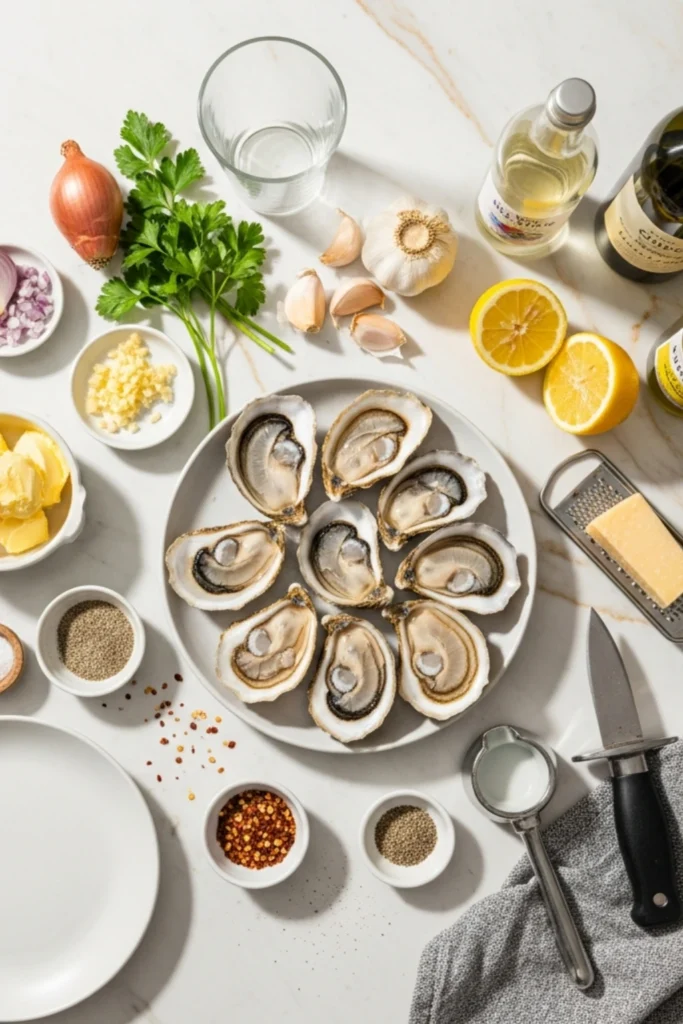
Tools You’ll Need
- 🦪 Oyster knife — non-negotiable. A regular knife will slip and you will cut yourself.
- Thick kitchen towel or cut-resistant glove — for holding the oyster steady while shucking
- Baking sheet or oven-safe dish — for the baked version
- Rock salt or crumpled foil — to keep oysters upright and stable in the pan
- Cast iron or stainless steel skillet — for pan-searing
- Large serving platter — crushed ice underneath keeps them cold
- Small mixing bowl — for the mignonette
- Microplane or fine grater — for fresh Parmesan
- Citrus juicer
Pro Tips for First-Timers
These are the things that actually make a difference when you’re making Pacific oysters at home for the first time.
1. Buy oysters the day you’re serving them. Pacific oysters are alive right up until you shuck them. Flavor drops fast. Same-day is ideal. Two days max — stored cup-side down in a bowl under a damp towel in the fridge.
2. Shuck over a bowl. The natural juice inside each oyster (called oyster liquor) is incredible. Shuck over a bowl to catch it, then spoon it back into the shell. This is the tip most people skip — and it’s a game-changer.
3. Cold makes everything taste better. Chill your serving platter and crushed ice before setting up. Cold intensifies that clean, briny sweetness and keeps raw oysters food-safe.
4. Don’t over-bake. Baked Pacific oysters need 5 to 7 minutes at 450°F. When the edges just start to curl and the butter bubbles, pull them out. Another 2 minutes and you’ve got rubber.
5. Rest them upside down before serving raw. One hour before serving, place oysters cup-side down on a tray in the fridge. This lets the liquor settle inside so it doesn’t spill when you shuck.
Substitutions and Variations
| Instead of… | Try This Instead |
|---|---|
| Pacific oysters | Kumamoto (creamier), Atlantic (brinier), Olympia (tiny and sweet) |
| Dairy butter | Vegan butter — works perfectly in the baked version |
| White wine (pan-seared) | Low-sodium chicken broth or dry vermouth |
| Parmesan | Pecorino Romano for a sharper, saltier bite |
| Parsley | Fresh tarragon or chives add a lovely twist |
| Classic mignonette | Try a cucumber-lime mignonette for something brighter and fresher |
Want to grill instead? Place shucked oysters directly on grill grates over high heat. Add garlic butter, close the lid, and cook for 3 to 5 minutes. One of the most satisfying ways to eat Pacific oysters in summer. 🔥
Love spice? A few drops of sriracha or a slice of pickled jalapeño on each raw oyster before serving is a genuinely great move. The heat balances the brine beautifully.
Make-Ahead Tips
Hosting tip: Most of the prep for Pacific oysters can be done well ahead of time — so you’re not frantically shucking in front of guests.
- Mignonette: Make up to 24 hours ahead. Refrigerate covered. The shallot mellow and the flavor deepens overnight. Stir before serving.
- Garlic butter compound: Mix butter, garlic, parsley, and lemon, roll in plastic wrap like a log, and refrigerate up to 5 days or freeze for 3 months. Slice rounds directly onto oysters when ready to bake.
- Shucking ahead (baked version only): Shuck up to 2 hours ahead, keep covered on a tray in the fridge, then bake when guests arrive.
- Raw oysters: Never shuck ahead. Eat immediately after opening.
Nutritional Breakdown
Six raw Pacific oysters contain roughly:
| Nutrient | Amount | % Daily Value |
|---|---|---|
| Calories | ~60 kcal | — |
| Protein | ~7g | 14% |
| Fat | ~2g | 3% |
| Carbohydrates | ~3g | 1% |
| Zinc | ~33mg | 300% |
| Vitamin B12 | ~16mcg | 660% |
| Iron | ~4mg | 22% |
| Omega-3s | ~600mg | — |
Pacific oysters are genuinely one of the most nutrient-dense foods on the planet. Six oysters give you three times your daily zinc and over six times your daily B12. That’s not a typo.
Dietary compatibility:
- ✅ Naturally gluten-free (watch sauces)
- ✅ Keto and paleo-friendly across all three versions
- ✅ Dairy-free with butter substitution
- ✅ High-protein
Meal pairing ideas:
- Crisp Muscadet, Chablis, or dry Champagne (the classic)
- Sauvignon Blanc for something more accessible
- Light lemon pasta as a main after oysters as a starter
- Shaved fennel and citrus salad on the side
For more on the health benefits of oysters, the Healthline overview is worth a read.
How to Make Pacific Oysters — Full Instructions
Raw Pacific Oysters with Classic Mignonette
Step 1: Make the mignonette
Combine minced shallot, rice wine vinegar, black pepper, sea salt, and lemon juice in a small bowl.
Stir well. Taste — it should be sharp, tangy, and slightly sweet.
Let it sit for at least 15 minutes (or make it the day before).
Step 2: Set up your serving platter
Fill a large platter with a thick layer of crushed ice or rock salt.
This keeps the oysters cold and stable while you serve them.
Step 3: Shuck the oysters
Wrap an oyster in your kitchen towel, cup-side down, hinge facing toward you.
Insert your oyster knife into the hinge and apply firm, steady pressure. Twist to pop it open — don’t stab, leverage.
Slide the knife along the inside of the top shell to sever the muscle, remove the top shell. Slide the knife under the oyster to loosen it from the bottom. Set on your platter over the ice.
Repeat for all 12.
Step 4: Serve immediately
Nestle oysters into the ice, place lemon wedges around them, and serve the mignonette in a small bowl with a spoon.
Garlic Butter Baked Pacific Oysters
Step 1: Preheat oven to 450°F (230°C).
Step 2: Make garlic butter
Mix softened butter, minced garlic, parsley, lemon juice, and red pepper flakes until smooth.
Season with salt and pepper. Taste it. Adjust.
Step 3: Prep the baking sheet
Spread rock salt or crumple aluminum foil across your baking sheet to create a bed.
This stops the oysters from tipping and losing all that butter.
Step 4: Top and bake
Place shucked oysters in their half shells on the prepared sheet.
Add about 1/2 tsp garlic butter to each. Top with a small pinch of Parmesan.
Bake 5 to 7 minutes until butter is bubbling and oyster edges just begin to curl.
Step 5: Serve immediately
Transfer to a platter in their shells. Serve with lemon wedges and crusty bread. 🧈
Pan-Seared Pacific Oysters
Step 1: Shuck oysters. Pat them lightly dry — moisture kills a good sear.
Step 2: Heat butter and olive oil in a cast iron skillet over medium-high heat until butter foams.
Step 3: Sear
Add oysters in a single layer. Don’t crowd them.
Sear 45 seconds to 1 minute per side until lightly golden.
Remove and set aside.
Step 4: Build the sauce
In the same pan, add garlic. Cook 30 seconds.
Add white wine. Let it reduce by half, about 1 minute.
Stir in lemon juice and parsley. Season.
Step 5: Plate oysters, spoon sauce over them, and serve with crusty bread right away.
Leftovers and Storage
| Version | Storage | Reheat Method | Max Time |
|---|---|---|---|
| Raw (unshucked, live) | Cup-side down, damp towel, fridge | Don’t store after shucking | Up to 2 days |
| Baked Pacific oysters | Airtight container, fridge | 350°F oven, 5 min | 1 day |
| Pan-seared | Airtight container, fridge | Low heat in butter, stovetop | 1 day |
| Garlic butter compound | Wrapped log, fridge or freezer | Slice straight from fridge | 5 days / 3 months |
Note: Never microwave oysters. They turn rubbery immediately.
FAQ
Are Pacific oysters safe to eat raw?
Yes — as long as they’re fresh and from a reputable source. Buy from a trusted fishmonger, check that shells are tightly closed before shucking, and eat them the same day. People who are pregnant, immunocompromised, or very young should avoid raw shellfish.
How do I know if a Pacific oyster is bad?
A bad oyster smells aggressively foul — not briny and oceanic, but genuinely wrong. Discard any oyster that doesn’t close when tapped before shucking, or that smells off after. When in doubt, throw it out.
Do I really need an oyster knife?
Yes. A regular paring knife will slip into your hand. An oyster knife is short, thick, and designed for leverage — not cutting. They cost under $15 and are absolutely worth having.
What’s the difference between Pacific and Atlantic oysters?
Pacific oysters (Crassostrea gigas) are larger, milder, and slightly sweet with a briny finish — popular along the West Coast of the USA and Canada.
Atlantic oysters (Crassostrea virginica) are brinier, saltier, and firmer. Both are excellent — it comes down to preference and availability.
Can I freeze fresh Pacific oysters?
You can freeze shucked oysters in their liquor for up to 3 months. The texture changes significantly, so frozen ones are better for chowders and pan fries than eating raw.
What wine pairs best with Pacific oysters?
Dry, high-acid whites are the classic pairing:
- Muscadet or Chablis — the traditional choice
- Dry Champagne or sparkling wine — reliably excellent
- Sauvignon Blanc — approachable and widely available
A simple rule: if the wine tastes good with a squeeze of lemon, it’ll pair well with oysters.
Can I skip shucking and just put them in the oven whole?
Yes — for baked oysters, place live oysters directly on a hot grill or in a 450°F oven. They’ll pop open on their own in about 5 to 8 minutes. Not as precise, but a solid option for beginners.
Wrapping Up
Pacific oysters are one of those recipes that sound impressive, taste incredible, and are genuinely less work than people think.
Once you’ve shucked your first dozen and watched garlic butter bubble over them in the oven, you’ll want to do it every weekend. And your guests will think you’ve suddenly become some kind of seafood expert.
Give one of these three versions a try and come back to tell me how it went. Did you go raw with mignonette, or did the baked version steal the show? Any questions about shucking technique, sourcing fresh oysters, or pairing ideas? Drop them in the comments below — I read every single one.